
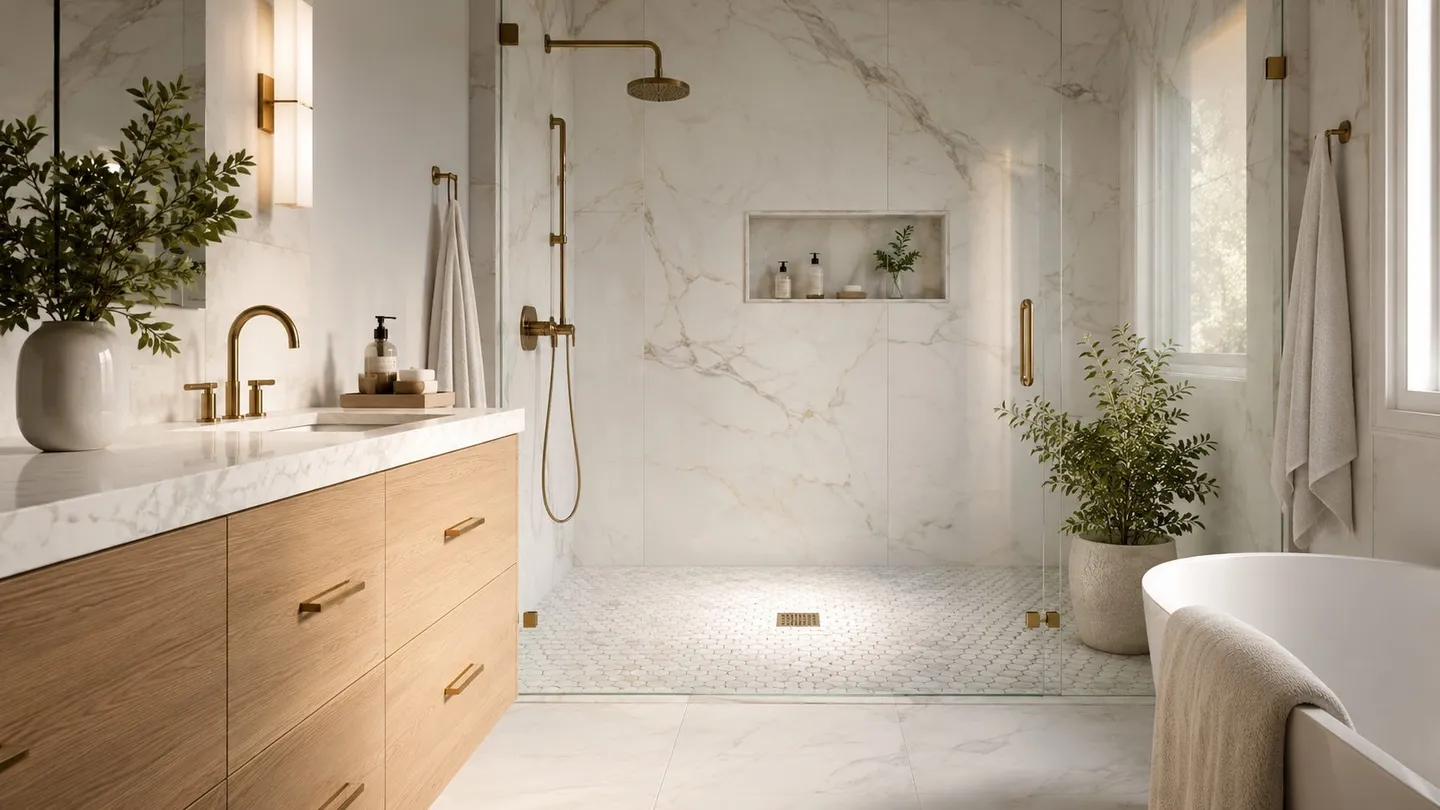
A beautiful shower can change the way an entire bathroom feels. Not because it contains the most expensive fixtures or follows a particular design trend, but because the materials work together. The floor is especially important. It is one of the first surfaces you notice when entering a walk-in shower, and it has to manage something decorative materials elsewhere in the home never encounter: water, foot traffic, drainage, grout, cleaning, and constant visual exposure.
That is exactly why choosing a marble shower floor tile deserves more thought than simply selecting the prettiest stone in a photograph.
Natural marble has character that manufactured surfaces deliberately try to imitate. One piece may carry delicate gray veining, another a warmer streak, and a third a subtle shift in tone. Put dozens of smaller pieces together in a mosaic, and those differences become part of the composition.
Done well, the result can feel calm, expensive, and completely individual.
Done poorly? The marble can compete with the rest of the room, the pattern may overwhelm a small shower, or the homeowner may discover too late that maintenance was never considered.
The goal, therefore, is not merely to find attractive marble. It is to choose the right marble, format, finish, pattern, and installation strategy for the room you actually have.
Why Marble Shower Floor Tile Continues to Stand Out
There are plenty of materials available for shower floors. Porcelain is practical. Ceramic provides an enormous range of looks. Large-format surfaces can create a minimalist appearance.
Marble offers something different.
Natural variation gives every installation a level of unpredictability that can be difficult to reproduce artificially. Carrara might introduce soft gray movement. Calacatta Gold can add more expressive veining with warmer accents. Thassos White creates a cleaner, brighter impression, while darker stones such as Nero Marquina or Emperador Dark can move a bathroom toward something moodier and more dramatic.
Surfaces Galore offers natural marble mosaics in multiple stone varieties and geometric formats, providing options for both understated and highly decorative interiors.
But there is another practical reason mosaics work particularly well on shower floors.
A marble shower floor tile does not necessarily mean a large square tile. In fact, smaller mosaic pieces are often visually more appropriate for shower bases because they can follow the shape and slope of the floor more naturally.
That creates an interesting relationship between design and function.
The same grout lines that divide the marble into an attractive pattern also give the floor more visual texture.
Small Pieces Can Make a Big Visual Difference
Imagine two bathrooms.
The first uses large pale tiles everywhere: floor, walls, and shower. It is clean, but potentially a little flat.
The second uses large-format stone or neutral wall tile but introduces a two-inch marble hexagon mosaic underfoot in the shower.
Suddenly there is contrast.
Not necessarily contrast in color. Contrast can come from scale.
That subtle change makes the shower floor feel intentional rather than merely covered.
As one designer might tell a hesitant homeowner:
“You don't need five different materials to make the bathroom interesting. Sometimes you only need one material used at a different scale.”
That is a useful principle to remember.
Choosing the Right Marble for Your Shower Floor
Searching for a marble shower floor tile can become confusing quickly because there are so many attractive options. It helps to stop thinking only in terms of “white marble” or “dark marble” and instead consider the atmosphere you want to create.
Carrara for Soft, Familiar Elegance
Carrara marble is one of the easiest stones to imagine in a bathroom. Its predominantly pale background and gray movement work with white cabinetry, wood vanities, chrome fittings, brushed metal, black accents, and many other combinations.
For a bathroom intended to feel bright without becoming sterile, Carrara mosaics are an obvious candidate.
They can also be forgiving from a design perspective. A highly expressive marble demands attention. Carrara can often sit quietly within the larger composition.
Calacatta Gold When You Want More Drama
Calacatta Gold introduces stronger visual movement and warmer veining than many softer white stones. Surfaces Galore carries Calacatta Gold mosaics in decorative formats suited to floors, showers, backsplashes, and accent applications.
A marble shower floor tile in Calacatta Gold can work particularly well when the bathroom includes warm metals, cream cabinetry, natural oak, or other materials that pick up its warmer details.
There is one caveat.
If you already have dramatically veined marble on the vanity, walls, and tub surround, another expressive pattern on the shower floor may become visually exhausting.
Luxury does not mean adding more of everything.
Sometimes restraint makes expensive materials look more expensive.
Thassos White for a Crisp Look
If the objective is brightness and minimal visual noise, a whiter marble can create a crisp foundation.
That can be especially effective in a compact bathroom where darker surfaces would visually reduce the space.
A white mosaic floor can also make decorative wall marble the hero rather than competing with it.
Dark Marble for a More Intimate Bathroom
Not every bathroom needs to look like a bright hotel spa.
Dark marble can create a completely different experience.
Consider a bathroom with walnut cabinetry, aged brass hardware, warm lighting, and an Emperador Dark or black marble mosaic underfoot. The result can feel intimate, architectural, and deliberate.
It is more demanding, however.
Water marks, soap residue, grout color, lighting, and maintenance can all affect how a dark surface appears. Anyone choosing a dark marble shower floor tile should evaluate the practical side before falling in love with a showroom sample.
Pattern Matters More Than Many Homeowners Expect
One of the strengths of marble mosaics is the variety of patterns available. Hexagons, herringbone arrangements, octagons, squares, basketweave-inspired designs, and other decorative forms can completely change the personality of the same stone.
Surfaces Galore highlights patterns ranging from classic geometric mosaics to herringbone, hexagon, and more decorative combinations.
Hexagon Marble for Modern Bathrooms
Hexagons occupy an interesting middle ground.
They are decorative enough to be noticed without necessarily looking ornate. A small hexagon pattern can suit a minimalist shower, transitional bathroom, boutique-hotel-inspired interior, or classic renovation.
For many projects, this makes hexagon marble shower floor tile one of the safest choices.
Square Mosaics for Simplicity
A traditional square mosaic allows the marble itself to do most of the visual work.
This makes sense when the stone has pronounced veining or color variation.
A Ming Green two-inch square mosaic, for example, introduces soft green tones and natural movement without relying on a complicated shape. Surfaces Galore presents this type of marble for bathrooms, showers, backsplashes, and decorative surfaces.
The lesson is simple: when the stone is expressive, the pattern does not always need to be.
Herringbone for Movement
Herringbone attracts the eye because it creates direction.
That can be beautiful on a shower wall or as a bathroom accent. On a shower floor, however, you should consider how much visual movement already exists elsewhere.
Suppose you have a strongly veined vanity top, patterned wallpaper outside the wet zone, and decorative brass fixtures. Adding intricate herringbone underfoot could push the room past sophisticated and into busy.
On the other hand, pair herringbone marble with plain white walls and a restrained vanity, and it becomes the feature.
Context changes everything.
Marble Shower Floor Tile vs. Marble Backsplash Tile
A material that works beautifully behind a kitchen counter does not automatically have the same demands when installed underfoot in a shower.
A marble backsplash tile is primarily a visual surface. It may encounter splashes, grease, cleaning products, and heat depending on its location, but people are not standing on it while it is wet.
The shower floor has a different job.
It must be integrated with the drainage design, waterproofing system, substrate, grout, and slope of the shower.
That makes installation decisions more consequential.
Where Backsplash Design Can Be More Adventurous
With a marble backsplash tile, you can often prioritize pattern and appearance more aggressively.
A polished decorative mosaic behind a range or vanity can catch light beautifully. Intricate shapes are easier to appreciate vertically because furniture and bathroom fixtures do not obscure them.
This is where highly decorative marble mosaics can shine.
For example, imagine white cabinetry, a quiet quartz countertop, and a dramatic Calacatta Gold mosaic backsplash.
You immediately know where the eye should go.
On a shower floor, the calculation is different. Beauty still matters, but performance characteristics, finish selection, installation and maintenance need equal attention.
What About Marble Mosaic Tile for Sale Online?
Buying marble online gives homeowners access to far more options than many local showrooms can physically display.
When browsing marble mosaic tile for sale, however, avoid shopping as though you were buying a manufactured product where every piece should look identical.
Marble is natural stone.
Variation is part of what you are paying for.
Two sheets from the same marble family may not be visually identical. Veining can move differently. One section may contain a stronger mineral pattern. Tone can shift.
This is not necessarily a defect.
It can be the feature.
Order With the Whole Installation in Mind
A common mistake is calculating the exact square footage and ordering almost exactly that amount.
That creates little room for cuts, layout decisions, breakage, selection, or future repairs.
Discuss ordering quantities with your installer before purchasing. The correct allowance depends on the layout, tile format, room geometry, pattern and installation conditions.
And when the marble arrives, do not immediately install one sheet after another directly from individual boxes.
Lay out enough material to understand the overall variation first.
This gives the installer a chance to distribute stronger and quieter pieces around the room rather than accidentally creating one heavily veined patch beside an almost uniform section.
That preparation can make the difference between an installation that looks naturally varied and one that simply looks inconsistent.
Polished or Honed? The Finish Deserves Serious Attention
A polished marble surface reflects more light and emphasizes color and veining. That makes it extremely appealing on walls, backsplashes, vanity surrounds, and decorative installations.
Honed marble has a softer, less reflective appearance.
Neither finish should be selected only because one looks more expensive in a photograph.
For a marble shower floor tile, discuss the proposed finish and wet-area suitability with the tile supplier and installer for the specific product. Surface texture, tile dimensions, grout joints, installation system and local requirements all matter.
This is one of those decisions where aesthetics should not overrule practical advice.
You may love the glossy sample.
Your installer may point toward another finish for the floor while suggesting the polished version for the shower wall.
That is not a disappointing compromise. It may produce a more interesting bathroom because the same stone can appear subtly different depending on its finish.
The Grout Color Can Change the Entire Floor
People often spend weeks choosing marble and five minutes choosing grout.
That is backwards.
Grout affects how strongly the mosaic pattern appears.
Take a pale marble hexagon.
With grout relatively close to the background tone of the stone, individual shapes may blend into a calmer overall surface.
Choose noticeably darker grout and every hexagon becomes more defined.
Neither is automatically better.
Ask yourself what you want people to notice first: the marble or the geometry?
The same issue applies to a marble backsplash tile. Contrast grout can emphasize patterns, while a more closely matched grout can allow veining and stone coloration to dominate.
Before installation, test the combination where possible.
A tiny grout sample beside one loose piece of marble does not always tell the full story. Several pieces together give you a better idea of how the finished surface will read.
A Practical Bathroom Scenario
Consider a homeowner renovating a medium-sized primary bathroom.
They want marble, but covering every wall in dramatic stone would push the project beyond budget and could make the space feel overly formal.
Instead, they choose:
- large neutral wall tile around most of the bathroom;
- a warm wood vanity;
- a simple light countertop;
- brushed brass fixtures;
- Calacatta-inspired marble for one shower feature wall;
- a smaller marble shower floor tile mosaic that connects visually to the feature wall.
Now marble is not everywhere.
It is where it matters.
The shower becomes the focal point, the vanity introduces warmth, and the quiet surrounding surfaces prevent the marble from feeling excessive.
This approach can also simplify future design changes. Towels, paint, accessories, mirrors, and lighting can evolve without requiring the expensive stone surfaces to be replaced.
Good design often comes from deciding where not to use the premium material.
Marble Shower Floor Tile in Small Bathrooms
A small bathroom creates different challenges.
Too many patterns can make the space visually fragmented. At the same time, using one large plain surface everywhere may make it feel anonymous.
Mosaic marble can solve that problem because it introduces detail inside a clearly defined zone.
Use the marble shower floor tile as a contained feature.
Keep the walls lighter.
Repeat one marble tone somewhere else — perhaps on the vanity backsplash, niche shelf, threshold, or small decorative element.
This repetition creates connection without turning every surface into a matching set.
There is also no rule saying the shower floor and bathroom floor need to be identical.
In fact, separating them visually can help define a walk-in shower even when frameless glass keeps the physical boundary nearly invisible.
Maintenance: The Part Nobody Should Ignore
Natural marble rewards homeowners who understand what they are buying.
It is not a material to choose while assuming it will behave exactly like porcelain.
Before installation, determine what sealing practices are appropriate for the specific marble, grout, finish, and installation. Ask which cleaning products are suitable for natural stone. Acidic or inappropriate cleaners may be problematic for marble surfaces.
Also consider your household.
A guest bathroom used several times a month is different from a family shower used repeatedly every morning.
A homeowner who enjoys maintaining natural materials may happily accept a surface that develops subtle signs of use over time.
Another person may want every surface to remain visually identical with minimal attention.
Both preferences are valid.
The mistake is buying marble without deciding which type of homeowner you are.
Marble Backsplash Tile Can Carry the Same Design Language
One of the easiest ways to make separate areas of a home feel connected is to repeat materials without copying entire rooms.
Suppose the primary bathroom uses Carrara hexagon mosaics.
The kitchen does not need the same hexagon pattern. Instead, a Carrara marble backsplash tile in a different format can reference the bathroom while maintaining its own identity.
Likewise, a powder room might use a darker marble from the same overall palette.
This creates continuity rather than repetition.
Surfaces Galorecarries natural marble mosaics intended for several types of applications, including kitchen backsplashes, bathroom floors, shower surfaces and decorative walls.
For designers working across an entire home, that range makes it possible to create related spaces without making them identical.
Common Mistakes When Selecting Marble Shower Floor Tile
Choosing From a Close-Up Photo Alone
A close-up shows veining.
It does not show how 30 square feet of the material will affect a room.
Always think in terms of the finished installation.
Ignoring Surrounding Materials
Cabinetry, wall tile, metal finishes, countertops and lighting alter how marble appears.
A warm marble under cool lighting can look different from what you expected.
Using Too Many Statement Surfaces
Statement vanity.
Statement floor.
Statement shower wall.
Statement wallpaper.
Statement lighting.
Eventually nothing is making a statement because everything is competing.
Give the eye somewhere to rest.
Assuming Natural Variation Is a Problem
Natural stone is not printed wallpaper.
Variation should be anticipated and intentionally distributed during layout.
Treating Installation as an Afterthought
The best marble shower floor tile will not rescue poor preparation underneath it.
Waterproofing, slope, drainage, appropriate setting materials, grout selection and experienced installation are fundamental to the finished result.
This is not the portion of the project where saving a few dollars makes sense.
When Marble Mosaic Tile for Sale Represents Real Value
Price per square foot is only one way to think about value.
If a mosaic becomes the defining material in a shower you will use for many years, spending more on a smaller area can sometimes make more sense than selecting expensive material throughout the entire bathroom.
That is why searching for marble mosaic tile for sale should begin with a design plan rather than a discount percentage.
Ask:
Where will the stone make the biggest visual difference?
Does the room need a subtle material or a dramatic one?
Could the mosaic be limited to a shower floor, niche, vanity wall, or backsplash?
Would a simpler surrounding tile make the marble look even better?
These questions often reduce unnecessary material costs while improving the overall design.
Why Real Marble Still Has Emotional Appeal
There is something slightly imperfect about natural marble.
That is precisely the attraction.
The vein may not run exactly where you expected. One mosaic piece may be lighter than the next. A pattern that appears subtle from three feet away reveals much more detail up close.
Those differences create depth.
A manufactured surface can offer extreme consistency, which is valuable in many projects. Marble offers individuality.
Neither approach is universally superior.
But if your goal is a bathroom that feels collected rather than manufactured, a carefully chosen marble shower floor tile can establish that character immediately.
Final Recommendation: Design the Shower From the Floor Up
The best shower designs are rarely the result of choosing materials independently.
Start with the experience you want.
Bright and calm?
Choose lighter marble and quieter geometry.
Warm and luxurious?
Explore marble with cream, beige or gold movement.
Architectural and dramatic?
Consider darker stone or stronger contrast.
Then look at the practical questions: tile scale, finish, grout, drainage, maintenance, material variation, installation and the surrounding surfaces.
A marble shower floor tile should look exceptional, but it also needs to make sense as part of a working wet area. That balance matters more than choosing whichever mosaic receives the strongest reaction in a showroom.
Surfaces Galore offers a broad selection of natural marble mosaics, including stones and patterns suitable for bathroom, shower and backsplash projects. Whether you are comparing a marble backsplash tile, searching for marble mosaic tile for sale, or building an entire bathroom around marble, start by thinking about how the stone will behave as part of the complete room rather than as an isolated sample.
And remember one rule that solves a surprising number of design problems:
Choose one element to lead, and let the others support it.
If the marble shower floor tile is going to be that element, give it enough visual space to do its job. The final bathroom will feel calmer, more considered, and far more personal.